
A benefits form sits unfinished on the table. You have a question about your Work Capability Assessment, a new symptom is worrying you, or you simply want to speak to someone who does not need disability explained to them. In those moments, disability peer groups versus forums is not an academic comparison. It is about finding support that feels safe, useful and manageable on the day you need it.
Both can bring connection and lived-experience knowledge. Both can also get things wrong, feel overwhelming, or leave you feeling unheard if they are not the right fit. The best choice depends on what you need right now, how you prefer to communicate, and whether you have the energy for a live conversation.
What a disability peer group can offer
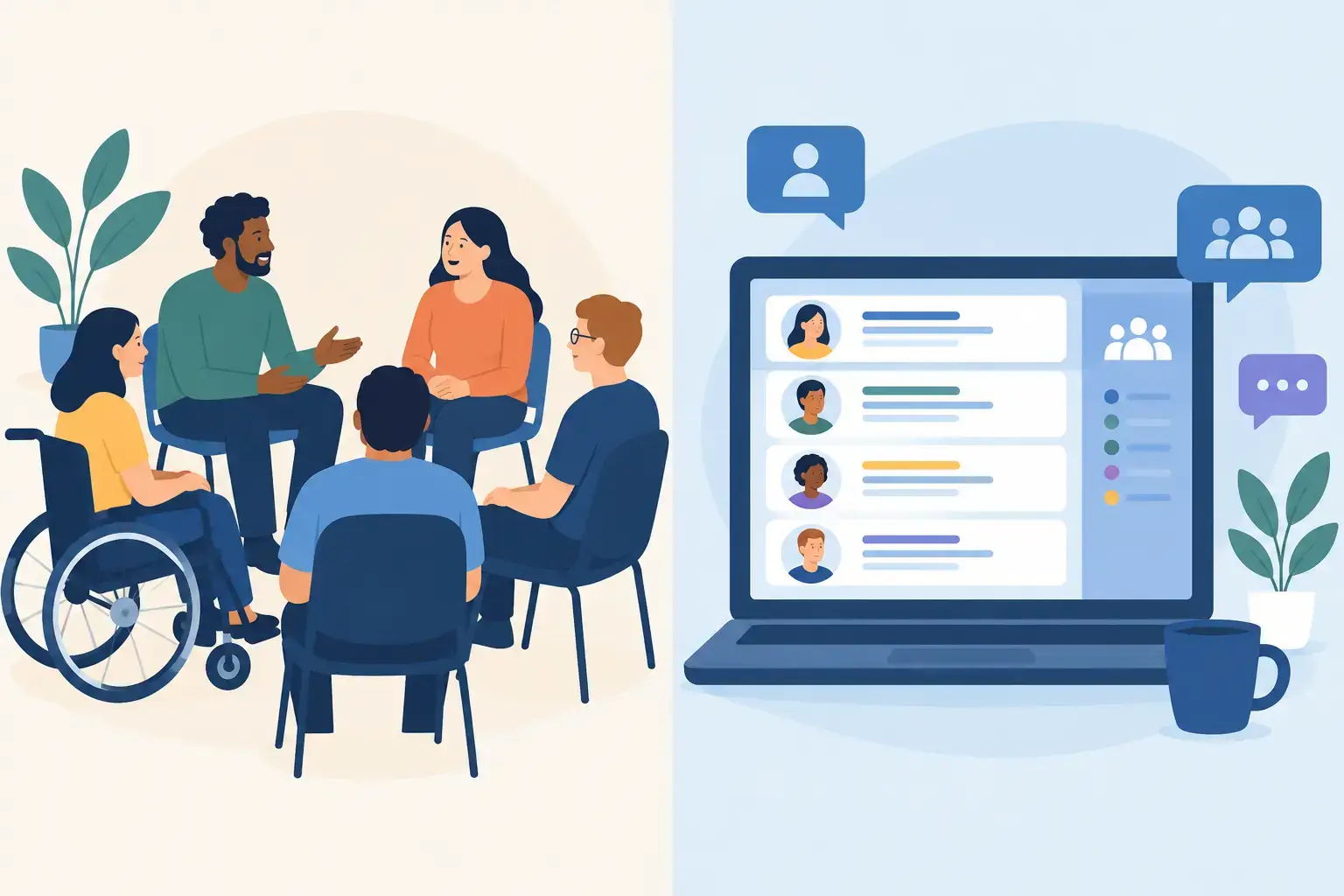
A peer group is a space where disabled people meet, either in person, by phone or online, to share experiences and support one another. Some groups are broad and welcome people with many different impairments or long-term conditions. Others focus on a specific condition, life stage or issue, such as chronic pain, autism, accessible travel, employment or carers.
The strongest part of a peer group is the human connection. You may hear someone describe the exact awkwardness of asking for adjustments at work, the exhaustion after a medical appointment, or the fear that comes with a brown envelope. That recognition can make a lonely problem feel less lonely.
Because conversations happen in real time, there is usually more room for context. You can ask follow-up questions, explain that your situation is complicated, and be met with a response that goes beyond a quick comment. Over time, familiar faces can build trust. For some people, that regularity is a lifeline.
There are trade-offs. Joining at a set time can be difficult if pain, fatigue, anxiety, caring responsibilities or transport make plans unpredictable. An in-person venue may not be fully accessible, even when it says it is. Group discussions can also move quickly, and speaking in front of others is not comfortable for everyone.
A good peer group should not expect you to disclose more than you want to. You should be able to listen quietly, leave early, use captions or chat where available, and ask about access needs without being made to feel like a problem.
What disability forums do differently
Forums are usually online discussion spaces where people post questions, share experiences and reply when they can. They may cover disability in general or have separate sections for benefits, work, health, relationships, mobility, social isolation and other everyday concerns.
Their biggest advantage is flexibility. If you are awake at 3am after a rough night, you can read previous discussions or write a post without needing to be present at a particular time. If speaking is difficult, painful or draining, writing can give you more control. You can take your time, edit your words and return when you have the energy.
Forums can also be brilliant for practical detail. Someone may explain how they prepared for an assessment, what documents helped them organise their thoughts, or how they approached an access issue when travelling. You can often find different experiences in one thread rather than relying on a single voice.
However, a forum is not the same as instant support. Replies may take hours or days, and sometimes nobody responds. Tone is easy to misread in writing, particularly when you are already stressed. A confident-sounding post can be based on old rules, a personal experience that will not apply to you, or plain misinformation.
It is worth remembering that people who had a difficult experience are often more likely to post than people whose situation was straightforward. That does not make their story less valid. It does mean you should treat it as one person’s experience, not a prediction of your own outcome.
Disability peer groups versus forums: the practical choice
Choose a peer group when you want conversation, encouragement and the chance to be known over time. It can be especially helpful when isolation is the main issue, when you need a confidence boost before dealing with a difficult task, or when you miss ordinary chats with people who understand the barriers involved.
Choose a forum when you need flexibility, prefer to write, or want to search for practical experiences before asking your own question. It may suit you better during a flare-up, when leaving home is not possible, or when you want to raise something sensitive without speaking aloud.
You do not have to choose one forever. Many people use both differently. They might read a forum to gather questions about Personal Independence Payment or work adjustments, then take those questions to a group discussion. Or they may meet people through a peer group and use a forum on the weeks they cannot attend.
The format matters less than whether the space respects you. You should not have to prove you are disabled enough, defend the way your condition affects you, or accept cruel comments as the price of belonging.
Check safety before sharing personal details
Lived experience is valuable, but it is not professional legal, medical or welfare-rights advice. Be cautious with anyone who promises a guaranteed benefits outcome, tells you to exaggerate your difficulties, pressures you to challenge every decision, or insists their route is the only right one.
For benefit claims and DWP processes, people can share useful tips about preparing, keeping copies and describing how a condition affects daily life. But the facts of your claim still need to be truthful and specific to you. Rules and guidance can change, so check current official information or speak to an appropriate adviser where possible.
Protect your privacy too. Avoid posting your full name, National Insurance number, address, claim reference, date of birth, medical documents or screenshots that reveal personal details. If a conversation moves into private messages very quickly, especially where money, romance or personal information is involved, slow down. A safe community will have clear moderation, reporting options and boundaries around abusive behaviour.
It is also reasonable to ask how a peer group is run. Is there a facilitator? What happens if someone is discriminatory or aggressive? Is the meeting location accessible? Can you join by phone or video? Are captions, breaks or a quieter way to participate available? These questions are not fussy. They help you decide whether the space has thought about disabled people in practice, not just in its welcome message.
How to get something useful from either space
Start small. You do not need to share your whole story in your first post or first meeting. A simple question such as, “How do you cope with the waiting and uncertainty around an assessment?” can tell you a lot about the tone of a community.
When advice comes in, look for patterns rather than chasing one definitive answer. If several people suggest keeping a diary of how your condition affects you, that may be a useful practical idea. If opinions differ sharply, that may reflect genuine differences in conditions, local services or individual circumstances.
Give yourself permission to step away as well. A discussion about appeals, discrimination or poor health can be validating, but it can also be emotionally heavy. Muting a thread, skipping a meeting or taking a break does not mean you have failed at community. It means you are looking after your energy.
The right support should leave room for you
The best support space is not necessarily the busiest, the most polished or the one where everyone agrees. It is the one where you can ask a real question, be treated with respect and leave with a little more clarity than you had before.
Talking Really exists for those real-life conversations: the practical questions, the frustrating systems and the days when you need someone to understand without judgement. Whether you begin with a peer group, a forum or a combination of both, take the first step at a pace that works for you. You deserve support that meets you where you are.