
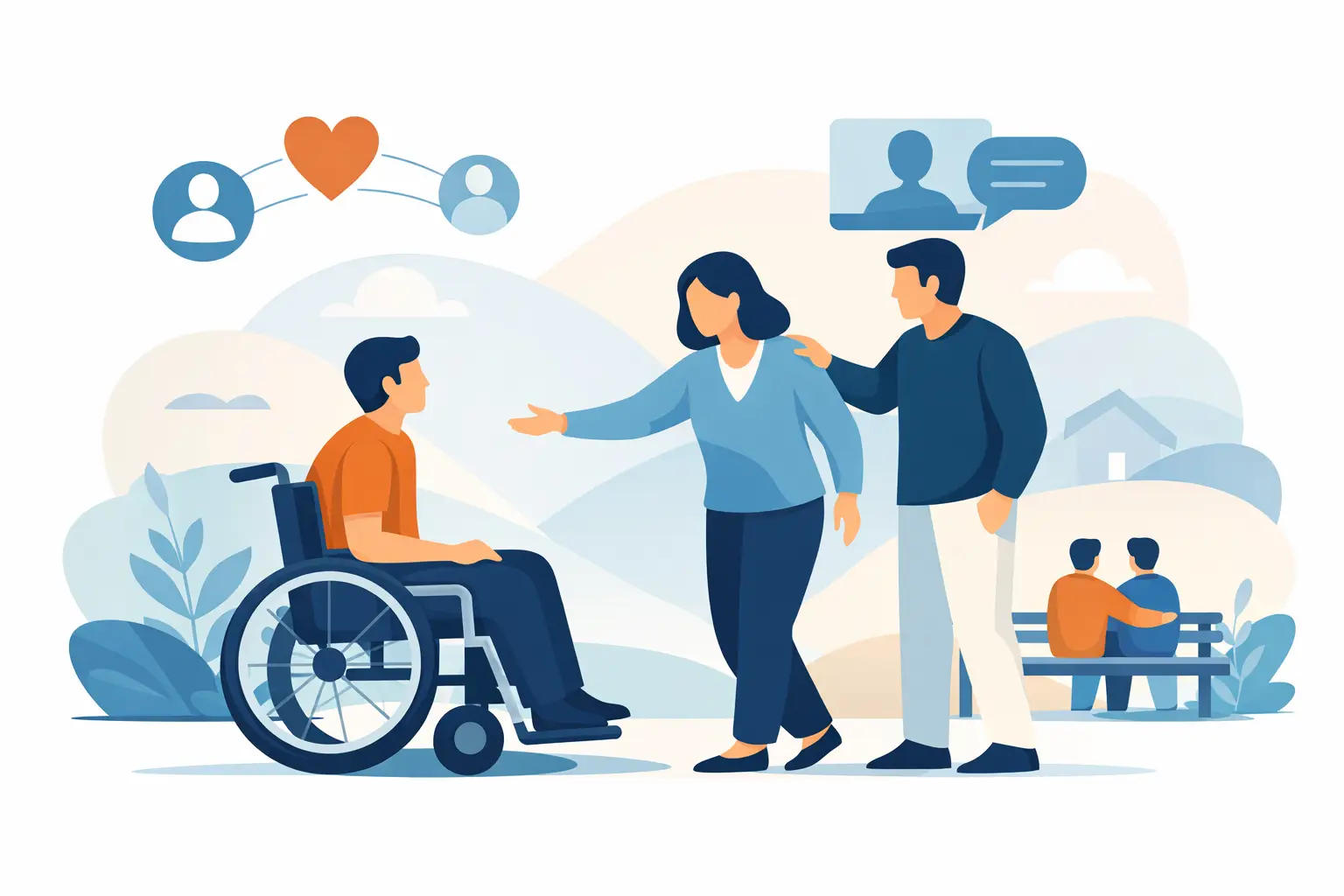
Some kinds of loneliness are hard to explain to people who have never lived it. You can be surrounded by family, carers, neighbours or online activity and still feel completely cut off. That is why help with disabled loneliness needs to be more than cheerful advice to just get out more or join a club. For many disabled people, the barriers are real, repeated and exhausting.
Loneliness can grow from pain, fatigue, access issues, money worries, transport problems, caring arrangements, stigma, benefits stress, or the simple fact that other people do not always know how to include you. It can also show up after a diagnosis, after losing work, after a relationship changes, or when your world gets smaller because your health does. None of that means you have failed socially. It means your circumstances have changed, and your support may need to change too.
Why disabled loneliness can feel different
Loneliness is not only about how many people you know. It is also about whether you feel understood, safe and able to be yourself. Disabled people are often expected to fit around other people’s comfort. That might mean masking pain, pretending you are less tired than you are, or avoiding honest conversations because you do not want to be seen as difficult.
Over time, that creates a very particular kind of isolation. You may be in contact with people, but not feel known by them. You may even stop reaching out because it feels easier than explaining your needs again. That is why generic social advice often misses the point. What helps one person may be impossible or draining for another.
There is also the issue of unpredictability. If your symptoms change, if travel becomes too much, or if appointments and assessments take over your week, it becomes harder to maintain friendships in the usual way. Some people understand that. Some do not. Losing those connections can be deeply painful.
Help with disabled loneliness starts with honesty
A lot of advice jumps straight to solutions. Before that, it helps to name what kind of loneliness you are dealing with. Are you missing company in general, or are you missing people who genuinely understand disability? Are you isolated at home, or are you out in the world but still feel invisible? Are you lonely because your confidence has dropped, or because practical barriers keep shutting doors?
Those differences matter. If you are exhausted and overwhelmed, forcing yourself into busy social settings may leave you feeling worse. If what you are missing is understanding, more contact with the wrong people will not fix it. The goal is not to look socially active. The goal is to feel less alone in a way that is sustainable.
It can help to ask yourself one simple question: what kind of connection feels possible for me right now? Not ideal. Not perfect. Possible. That might be one regular phone call, an online group you can join without showing your face, a local activity with proper access, or one trusted person you can speak honestly with.
Start smaller than you think
When loneliness has built up over time, it is easy to think the answer has to be big. A full social life. New friends. Constant plans. Usually, that is too much pressure. Small, repeatable contact is often more useful than one ambitious attempt that leaves you shattered.
A short check-in with someone once a week can matter more than a packed day out once every few months. A regular online space where you recognise names can do more for your wellbeing than chasing lots of new interactions. Familiarity builds safety. Safety makes connection easier.
This is especially true if anxiety, fatigue, pain or past rejection are part of the picture. You do not need to perform confidence to deserve company. You need contact that respects your energy and your reality.
Choose connection that matches your energy
Think about the way you communicate best when you are not having a good day. Some people prefer voice notes because typing hurts. Some prefer text because speaking is tiring. Some like live chats. Others need slower, less pressured contact.
There is no gold standard. If a form of connection works for you, it counts. That matters because disabled people are often told that online friendships are somehow lesser. They are not. For many people, online spaces are the most accessible way to build genuine relationships.
What can make loneliness worse
Not all attempts to fix loneliness actually help. Sometimes the pressure to be positive, available or grateful can make things heavier.
One common problem is pushing yourself into spaces that are technically open to everyone but not truly welcoming. If you spend all your energy managing access problems, awkward comments or poor understanding, you are unlikely to leave feeling connected. Inclusion is not just about getting through the door. It is about whether you can relax once you are there.
Another issue is relying only on people who support you practically. Carers, family members and professionals may be important, but they do not always replace friendship or peer connection. Being looked after is not the same as being emotionally met.
Then there is the habit of withdrawing before anyone can let you down. That response makes sense, especially if you have been dismissed or excluded before. But it can slowly turn protection into isolation. If that feels familiar, be gentle with yourself. The answer is not to trust everyone. It is to test safer spaces, slowly.
Building connection in a way that feels safer
Good help with disabled loneliness usually combines practical steps with emotional permission. Practical steps matter because access, money and transport are real barriers. Emotional permission matters because many disabled people feel guilty for needing support, or ashamed that loneliness has become such a big issue.
Try to remove one barrier at a time. If travelling is hard, start with remote contact. If group settings are too much, look for one-to-one conversation. If cost is the problem, focus on free community spaces, peer groups or low-pressure activities. If unpredictability is the issue, be upfront that you may need flexibility.
It also helps to say what you need in plain language. That could be as simple as, “I would like to stay in touch, but I am not always able to reply quickly,” or “Phone calls are easier for me than meeting in person right now.” The right people usually respond better to clarity than to silence.
Peer support can change the picture
There is something powerful about not having to explain everything from scratch. Peer support does not solve every problem, and not every disabled person will click with every group, but being around people who already understand access issues, fatigue, bureaucracy or stigma can ease the pressure immediately.
That shared understanding can make connection feel less like work. You are not translating your life all the time. You are talking to people who already get why cancelled plans, hospital appointments, mobility aids, mental strain or benefits stress affect everyday relationships.
For some people, community spaces such as forums, live chats, phone-ins or small discussion groups are a better fit than traditional social activities. That is one reason platforms like Talking Really can matter. They do not treat isolation as a side issue. They recognise it as part of real life for many disabled people.
When loneliness is affecting your mental health
Loneliness can chip away at confidence, sleep, motivation and self-worth. It can make you feel as though you have disappeared from other people’s lives, or that asking for company makes you a burden. If that is where things have got to, please take that seriously.
You do not need to wait until you are in crisis to ask for help. Speaking to your GP, a mental health service, a trusted support worker or a peer-led community can be a sensible next step. If your loneliness is tied up with depression, anxiety, grief or trauma, social advice on its own may not touch the deeper problem.
It is also worth paying attention to your inner voice. If you notice thoughts like “no one wants to hear from me” or “I always ruin things”, that may be loneliness talking, not the truth. Isolation distorts perspective. A small bit of outside contact can interrupt that spiral.
Give new connections time
One of the hardest parts of loneliness is that it makes every interaction feel high stakes. You may hope one conversation will fix everything, and then feel crushed when it does not. Most meaningful connection does not happen in one go. It builds through repetition, trust and ordinary contact.
So if the first step feels awkward, that does not mean it was the wrong step. It may simply mean you are out of practice, tired, or still working out what feels safe. That is normal. Real talk for real people means admitting that connection can be messy, slow and uneven.
You deserve relationships where you do not have to shrink yourself to be included. You deserve support that understands the practical barriers as well as the emotional weight. And if loneliness has been part of your life for a long time, change may start quietly - with one reply, one conversation, one space where you do not have to explain why this is hard.