
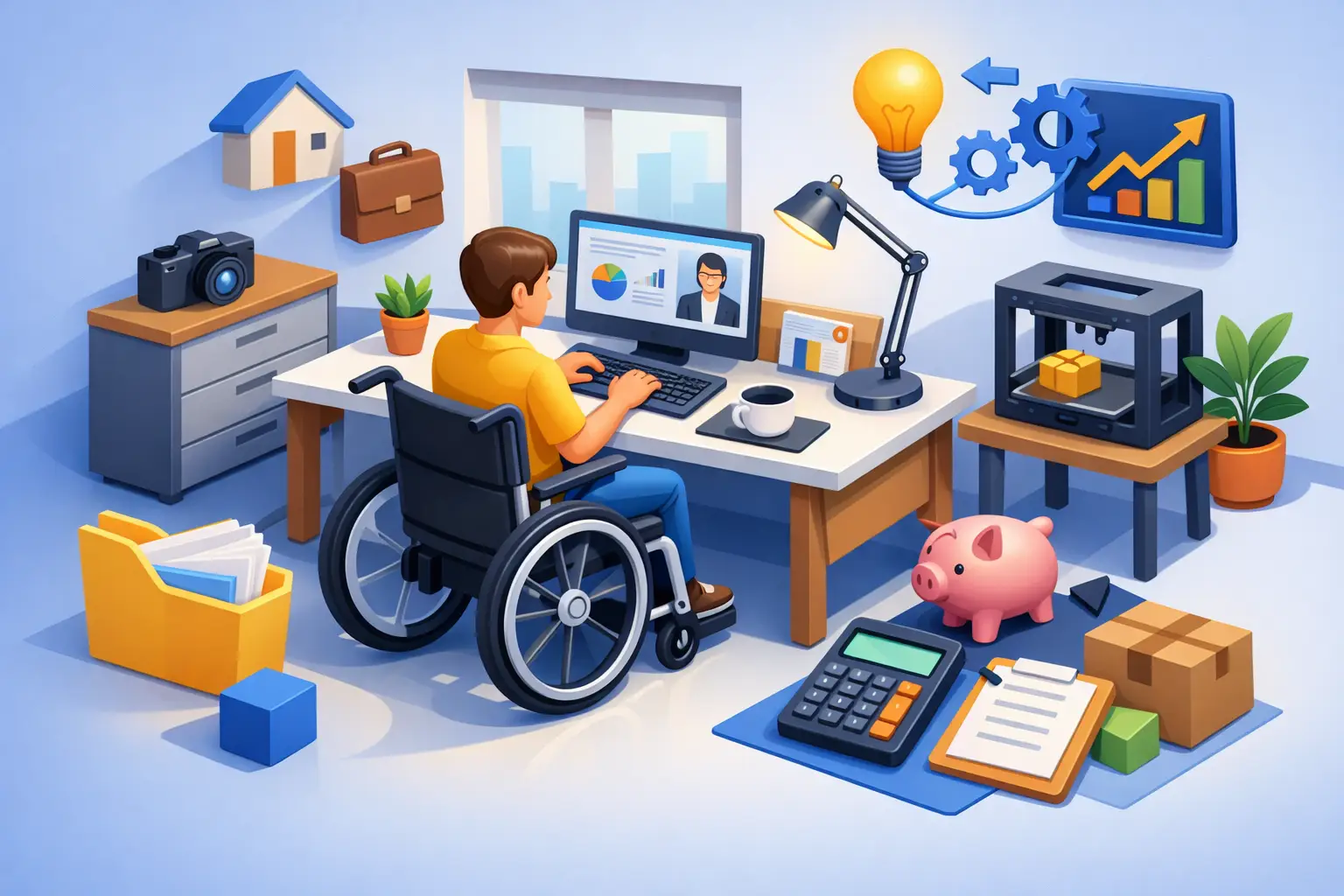
Some jobs are built around the idea that everybody can sit, stand, travel, socialise and concentrate in the same way every day. Real life does not work like that. If you are looking at how to start disabled self employment, there is a good chance you are not chasing some glossy business dream. You are trying to build work around your body, your mind, your energy and your reality.
That is a sensible place to start.
Self-employment can offer flexibility that many disabled people do not get in traditional work. You may be able to choose your hours, work from home, pace tasks around pain or fatigue, and shape a role that uses what you can do rather than punishing you for what you cannot. But flexibility is not the same as ease. Running your own business can be tiring, admin-heavy and financially uneven, especially at the beginning.
How to start disabled self employment without burning out
The first step is not picking a business name or making a logo. It is being honest about your capacity. That means asking what kind of work fits your health, not what sounds impressive to other people.
Think about your day as it really is. When do you function best? What triggers symptoms? How much social contact can you manage? Are you reliable in short bursts but not for long stretches? Do you need to avoid travel, noise, stress or rigid deadlines? These questions matter because the wrong business model can leave you worse off, even if the idea itself is good.
For example, selling handmade items may sound manageable until you factor in packing, post office trips and customer messages. Freelance admin might suit somebody who prefers home-based computer work, but not somebody whose concentration varies wildly. Dog walking may look simple on paper, but it depends on stamina, weather and reliability. There is no shame in ruling things out.
A better starting point is to match your skills to a workable format. Ask yourself what you already know, what people already ask you for help with, and what can be done in a way that respects your access needs. That might be bookkeeping, tutoring, proofreading, crafting, virtual assistance, content creation, consulting, pet sitting, baking, sewing alterations or selling digital products. Start with what is realistic, not what social media tells you a business should look like.
Check how self-employment affects your benefits
This is the bit many people worry about, and rightly so. If you get Universal Credit, ESA, PIP or other support, self-employment can affect your claim in different ways. It depends on which benefits you receive, whether your work is classed as permitted, how much you earn, and what reporting rules apply.
PIP is not means-tested, so earnings do not directly reduce it. But if the work you do appears to conflict with the difficulties described in your claim, that can still raise questions later during a review. That does not mean you cannot work. It means you need to be clear and honest about what support, adaptations, pacing or consequences sit behind that work.
Universal Credit is more complicated because you will usually need to report that you are self-employed and declare your earnings and expenses. There can also be questions around whether your work counts as gainful self-employment. If you have limited capability for work or limited capability for work-related activity, your circumstances may be treated differently than someone expected to look for full-time work. ESA has its own rules around permitted work, and those rules need checking carefully before you start.
This is one of those moments where getting proper benefit advice is worth it. A small decision made early can save a lot of stress later.
Start smaller than you think you need to
A lot of disabled people feel pressure to make self-employment look serious from day one. In reality, smaller is often safer.
That might mean taking one paying client instead of five, selling a limited number of products each month, or testing a service through people you already know. The goal at this stage is not rapid growth. It is proof that the work is doable, sustainable and worth continuing.
Starting small also gives you space to notice hidden demands. Chasing invoices, replying to customers, updating records and dealing with cancellations can be harder than the actual paid work. If your energy is limited, these background tasks need to be part of the plan.
One simple way to protect yourself is to build your business around fewer moving parts. A complicated offer with endless choices often creates more admin and more pressure. A clearer, simpler service is easier to explain and easier to deliver.
Set up the practical bits in a way that works for you
Once you know what you want to offer, you can deal with the setup. In the UK, many people start as sole traders because it is the simplest route. You will need to register with HMRC if you become self-employed and meet the relevant threshold for trading income, and you will need to keep records of income and allowable expenses.
Do not leave the record-keeping until later if admin is already a struggle. Pick a simple system now. That could be a spreadsheet, a notebook kept consistently, or accounting software if that is easier for you. The best system is the one you can actually keep up with when you are tired.
You will also need to think about banking, invoicing and how people will pay you. Keeping business money separate from personal money usually makes life easier. It is not about looking official. It is about reducing confusion.
If you need adjustments, build them in from the start rather than waiting until things go wrong. That could mean using speech-to-text, scheduling software, templates for repeat messages, adaptive equipment, quieter workspaces, delivery collection services or strict communication boundaries. Access needs are not extras. They are part of your business setup.
Money matters, but so does pacing
Many articles on self-employment focus on income goals. For disabled people, pacing matters just as much.
A business that brings in a bit less money but leaves you well enough to function may be a better choice than one that pays more and wipes you out. That can be hard to accept, especially if money is tight. But the point of self-employment is not to recreate the same pressure that made ordinary work inaccessible.
It helps to work out your bare minimum. What do you need your business to cover, and by when? If you are also receiving benefits, how will fluctuating income affect your month-to-month budgeting? Self-employment income can be uneven, and that can be stressful if every bill is already a juggling act.
Try to budget for slower months from the beginning. If you earn more one month, it does not always mean things are sorted. It may simply mean next month will be quieter, or your health may dip and reduce what you can do.
Confidence and credibility can look different when you are disabled
A lot of business advice assumes you should always be available, always upbeat and always ready to sell yourself. That is not realistic for many people.
You do not need to pretend to be endlessly energetic to be credible. You need to be clear about what you offer, what clients or customers can expect, and what boundaries are in place. In fact, that clarity often makes people trust you more.
If communication is difficult, write standard replies for common situations. If you need longer turnaround times, say so. If appointments need to be remote, build your service around that. The right customers are usually not put off by reasonable boundaries. The wrong ones would drain you anyway.
There is also nothing wrong with building a business slowly and quietly. Not everybody wants to become a visible brand. Some people want a manageable income and more control over their day. That is a valid goal.
How to start disabled self employment with support around you
Doing this alone can be hard, especially if you are also dealing with assessments, treatment, pain, fatigue or isolation. Support matters, even if your business is only part-time.
That support might be practical, like somebody helping with bookkeeping or post office runs. It might be emotional, like having people who understand what it means to work around fluctuating health. It might be professional, such as benefits advice or help with access needs. If you can build even a small support network, the whole thing becomes less fragile.
This is also where community makes a difference. Talking Really exists because disabled people often need straightforward advice without judgement, and self-employment is no different. Sometimes what helps most is hearing from people who know the gap between official guidance and daily reality.
If your health changes, your business may need to change with it. That is not failure. It is adaptation. You might reduce hours, simplify your offer, pause temporarily or switch direction entirely. The people who last in self-employment are not always the ones who push hardest. Often, they are the ones who notice when something is not working and adjust before it breaks them.
Starting disabled self-employment is not about proving anything. It is about building work that fits your life closely enough to be possible. Go steady, protect your energy, check the benefit rules early, and let practical reality lead the decisions. A business does not need to look big to make a real difference to your independence.