
The hardest part of a rail journey is not always the train itself. It can be wondering whether someone will meet you, whether there will be a ramp, or what happens if a delay means you miss your connection. This guide to accessible train assistance is about taking some of that uncertainty out of the day, while being honest about where the system can still fall short.
Train travel should not require you to prove that you deserve help. If you are disabled, have a long-term condition, are recovering from illness or injury, are neurodivergent, have a sensory impairment, or simply need practical support to travel safely, assistance is there for you.
What accessible train assistance can help with
Across Great Britain, train operators provide Passenger Assist. This is the name generally used for free help when travelling by rail. You do not need to have a Disabled Persons Railcard, receive a particular benefit, use a wheelchair or carry medical evidence to ask for it.
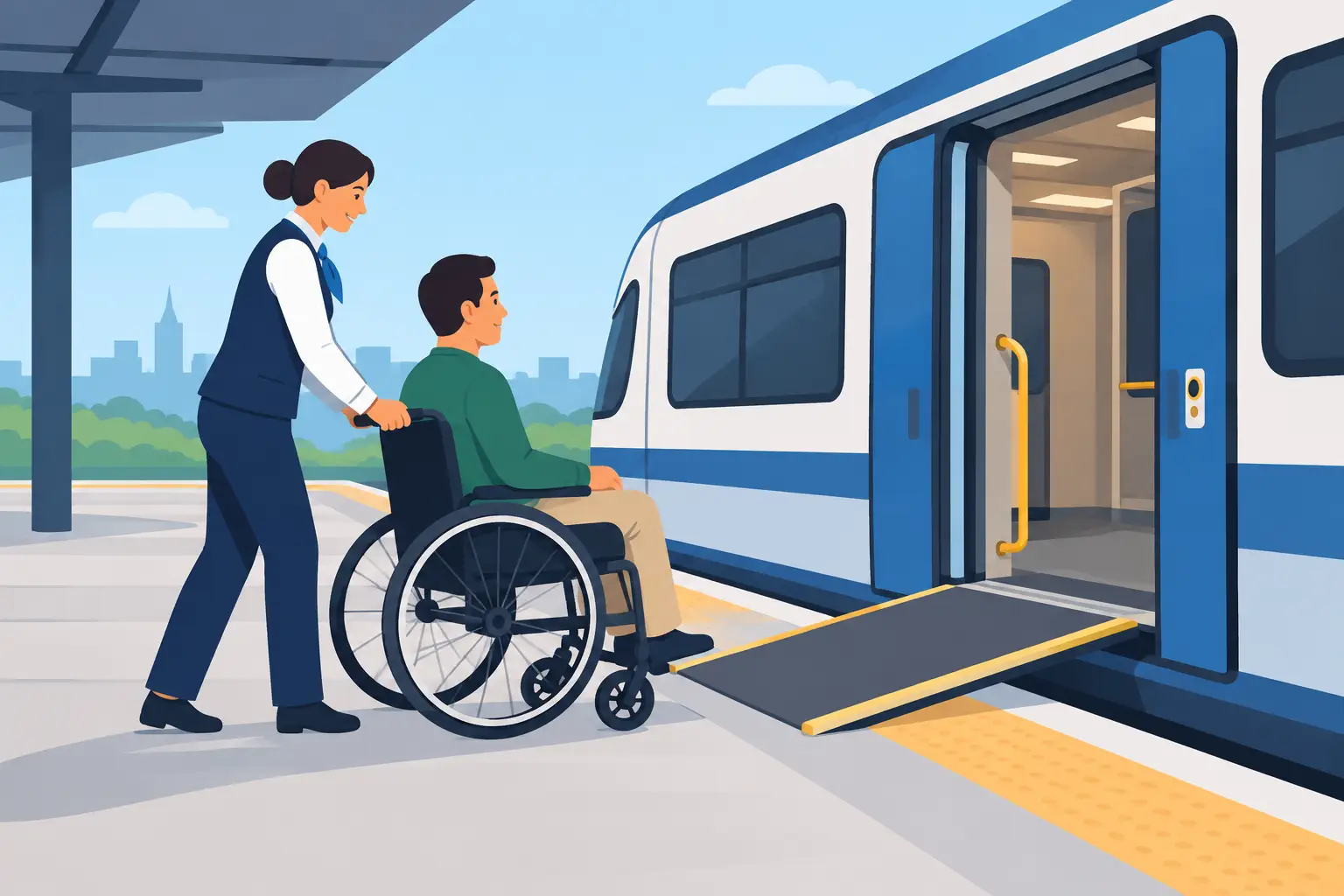
The support available depends on the station, train company and your individual needs. It can include being met at a station, finding the right platform, help getting on or off the train, a ramp for a wheelchair or mobility scooter, help with a connection, and being guided through an unfamiliar station. Staff may also be able to help with luggage, though this is usually limited to what one person can safely handle.
For some people, the most useful support is physical. For others, it is having clear information, avoiding a busy route through a large station, or knowing somebody will explain a last-minute platform change. Tell the railway what would make the journey workable for you rather than trying to fit your needs into a tick-box description.
There are limits. Passenger Assist is not personal care. Staff cannot normally help with eating, toileting, medication, lifting you manually, or provide constant supervision throughout a journey. If you need that level of support, travelling with a companion may be safer. That does not mean you should avoid assistance - it can still make the railway part of the trip far less stressful.
How to book accessible train assistance
You can book Passenger Assist through a train operator, using the national Passenger Assist service, or through some train booking apps and websites. You can usually arrange help for a journey involving more than one train company in one booking, which matters if you have several connections.
Book as early as you can, especially for a long trip, an early-morning service, a weekend journey or travel during school holidays. Booking ahead gives staff time to arrange support at every station. However, needing to travel at short notice does not mean you should stay at home. Many stations offer a “turn up and go” approach where possible, so speak to a member of staff or use the help point when you arrive. Assistance may take longer to arrange without notice and cannot always be guaranteed, particularly at unstaffed stations.
When booking, give yourself permission to be specific. Say if you use a wheelchair, walking frame, white cane, hearing aid, assistance dog, oxygen equipment or another mobility aid. Explain if standing for long periods is difficult, crowds cause distress, you need spoken information repeated, or you are unable to manage stairs. If you have a booked seat or need a wheelchair space, mention that too.
It helps to confirm four things before you finish the call or form: where staff will meet you, how early they want you to arrive, what help is arranged at each change, and what number to call if something goes wrong. Keep your booking reference, journey details and any seat reservation together on your phone or written down.
Build in time that protects your energy
Railway advice often tells passengers to arrive early. That can be sensible, but it can also mean sitting in pain, managing fatigue or becoming overwhelmed in a crowded station. There is no single right amount of time.
As a starting point, allow enough time to reach the meeting point without rushing, use an accessible toilet if needed, and deal with a queue or lift problem. For an unfamiliar major station, extra time is usually worth it. For a small station you know well, too much waiting may be harder than the journey. Plan around your body and mind, not around what a confident non-disabled traveller might do.
Before you set off: check the details that matter
Not every station is step-free, and “accessible” can mean different things in practice. A station may have ramps but no staff late in the evening, lifts that are temporarily out of service, or a step-free route that is much longer than expected. Check the accessibility information for every station in your journey, including connections.
If you use a powered wheelchair or mobility scooter, check the operator’s guidance on size, weight and safety rules before travel. Most rail companies can accommodate many mobility devices, but train layouts vary. A device that fits one service may not fit another, especially on older trains or replacement buses.
It is also wise to check for engineering works. A rail replacement bus can turn an accessible train journey into a very different experience, particularly if you cannot transfer from your wheelchair or need space for equipment. Ask what accessible alternative will be provided rather than assuming the standard bus arrangement will work.
Bring essentials in a way that keeps your hands and energy free where possible: charged phone, medication you may need, water, battery pack, tickets, booking details and warm layers. Delays happen. This is not about expecting the worst; it is about making a difficult day more manageable if plans change.
When delays or missed connections happen
This is where accessible train assistance is tested. If your train is delayed, tell staff as soon as you can that you have assistance booked, especially if you are likely to miss a connection. Do not assume the next station knows what is happening. Staff should communicate onward, but a quick reminder can prevent you being left trying to navigate a new plan alone.
If you are on board and need help, speak to the conductor or use the train’s help point where available. If you cannot safely get off at an altered platform, or no ramp arrives, remain where you are and make staff aware. You should not be expected to attempt steps, jump a gap, or put yourself at risk to keep the service moving.
Sometimes the best option is not the fastest one. You may decide to wait for a direct train, take a later connection with confirmed help, or contact someone to meet you. That is not failure. Independence is being able to make a choice that protects your safety, comfort and dignity.
If assistance does not turn up
Being missed is upsetting, particularly if you have carefully planned around pain, anxiety, continence needs or limited energy. First, make yourself safe. Use a help point, contact station staff, or call the assistance number you booked through. If you are stranded, say plainly what you need and whether you are at risk of being unable to travel home.
Make a note of the time, station, service, who you spoke to and what happened. This can help if you make a complaint later or ask for compensation for a delayed journey. You do not have to deal with the complaint while you are exhausted at the station. Getting home safely comes first.
A useful complaint is specific: explain the assistance booked, the impact of it not being provided, and what you want the operator to do. That might be an explanation, reimbursement, staff training, or a practical commitment about future journeys. Your experience is evidence of where the system needs to improve.
A few choices that can make travel easier
A direct train is not automatically the best journey if it leaves from a difficult station or gives you no chance to rest. Equally, two easy, well-supported connections may be more reliable than one tight change at a large station. Compare the whole journey, not just the arrival time.
If crowds, noise or unpredictability are a problem, travelling outside peak times can help. A quiet coach may be useful for some people, though it is not always silent and it is not a substitute for proper assistance. If you rely on a particular seat, book it where you can, but be prepared for train formations to change.
You may find it reassuring to do a short practice journey first, perhaps with a friend or family member. There is no shame in that. Confidence often comes from knowing the process, not from forcing yourself through the most difficult possible version of a trip.
At Talking Really, we know that travel advice only works when it allows for real life: fatigue that changes by the hour, pain that does not follow a timetable, and the worry of being left without support. You are allowed to ask for help, to ask again, and to choose a different plan when the first one no longer feels safe. A train journey is not a test of your worth or independence. It is simply a journey, and you deserve to make it with dignity.