
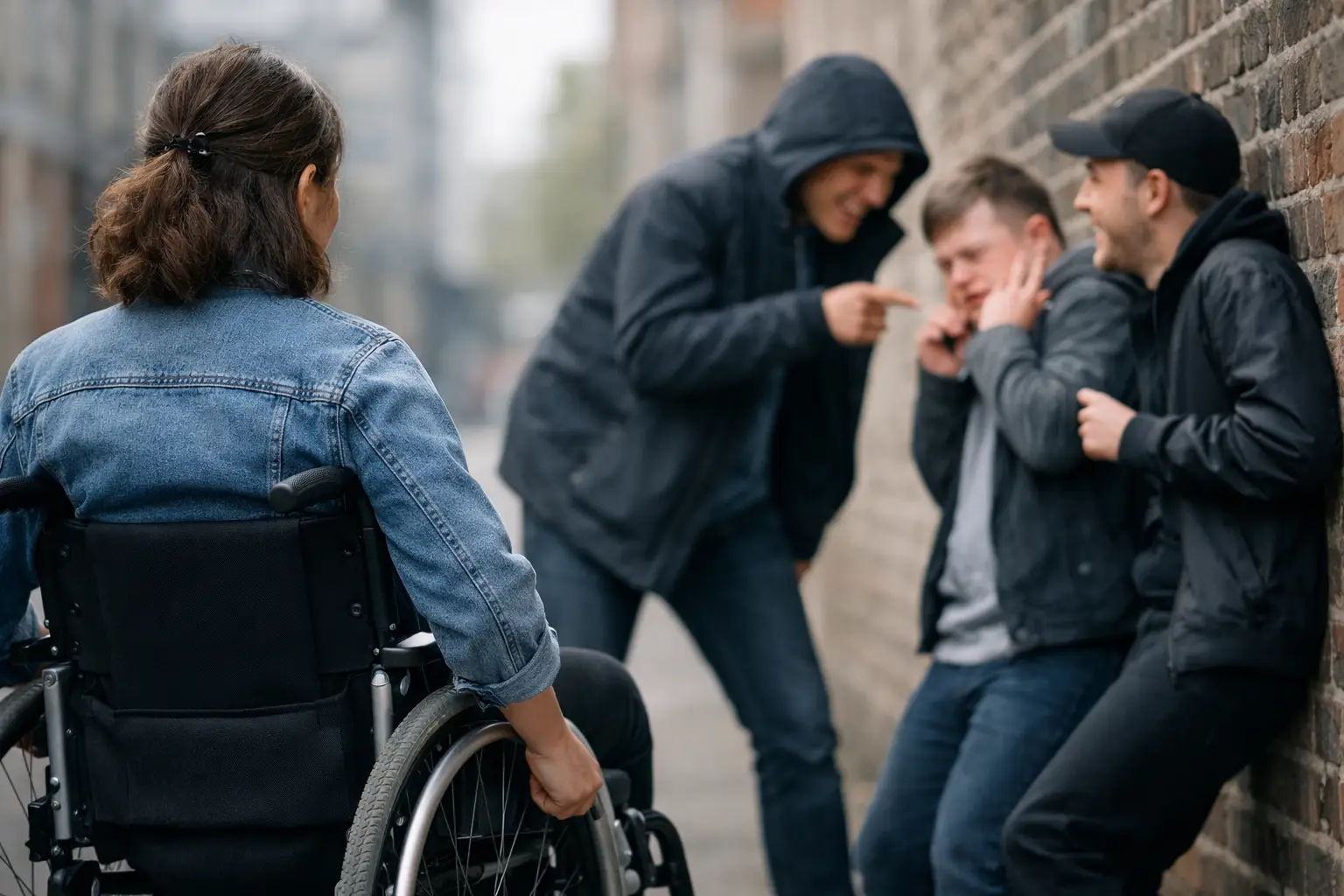
Someone shouting abuse from a car, a neighbour repeatedly mocking your impairment, strangers filming you in public, or a person you know pressuring you for money because they see you as an easy target - none of this is something you should have to brush off. It can be frightening, exhausting and isolating. This guide to disability hate crime explains what it can look like, what you can do next, and how to get support in Great Britain.
What is disability hate crime?
Disability hate crime is a crime motivated by hostility or prejudice towards someone because they are disabled, or because the offender thinks they are disabled. The person targeted does not need to have a particular diagnosis, visible impairment or formal proof of disability. What matters is what happened and why the offender appears to have acted that way.
In practice, the law can feel less straightforward than the experience. You may not know whether someone was motivated by hostility, especially if they used vague language or tried to pass their behaviour off as a joke. You do not need to work that out alone before reporting it. Tell the police what happened, what was said or done, and why you believe your disability was relevant. They can assess the evidence.
In England and Wales, a court can increase a sentence where an offence was motivated by hostility towards a disabled person, or where the offender showed that hostility during the offence. Scotland has its own hate crime legislation, including disability aggravations. The route through the law differs, but the basic point is the same: disability-related hostility should be taken seriously.
A hate incident is behaviour that is not necessarily a criminal offence but is perceived by you, or someone else, to be motivated by hostility or prejudice. Reporting an incident can still matter. It creates a record, helps police see patterns and may prevent behaviour escalating.
Disability hate crime is not always obvious
Many people picture a hate crime as a direct attack by a stranger. That happens, but it is not the only form. It may take place in your street, on public transport, at work, in supported housing, at college, online or within a relationship.
It can include threats, assault, criminal damage, theft, harassment, stalking, sexual abuse, coercive behaviour, humiliating comments, unwanted touching, or people deliberately interfering with equipment such as a wheelchair, mobility aid or communication device. Online abuse counts too, whether it arrives through social media, gaming platforms, email or messages.
Sometimes it is repeated low-level behaviour: a group calling names outside your home, a colleague mimicking the way you speak, or someone making every disagreement about your mental health. One incident may not show the full picture. A record of repeated behaviour can.
When exploitation is dressed up as friendship
Disabled people can also experience what is often called mate crime. This is where somebody pretends to be a friend but takes advantage - perhaps borrowing money and never repaying it, taking over your benefits, using your home, pressuring you into things, or encouraging others to laugh at you.
Not every difficult friendship is a hate crime, and not every exploitation case will meet the legal test for one. But that uncertainty must not stop you seeking help. If you feel controlled, used, unsafe or singled out because of your disability, speak to someone you trust. Your instincts deserve room.
What to do if you are in danger
If you or somebody else is in immediate danger, call 999. If speaking is difficult or unsafe, use the emergency contact option that works for you, such as text relay where available, or ask another person to make the call. Tell the operator where you are, what is happening, and whether the person has threatened or hurt you.
If the danger is not immediate, give yourself permission to step away before deciding what to do. Go somewhere safer, call someone you trust, sit with a neighbour, or ask staff at a shop, station or venue for help. You do not have to confront the person, gather perfect evidence or explain your disability to earn protection.
If abuse happens at home and the person knows your routines, consider what would make the next few days safer. That might mean changing who has access to your flat, telling a support worker, arranging somewhere to stay, or agreeing a code word with someone you trust. The right plan depends on your situation. Safety comes before proving a point.
How to report disability hate crime
For a non-emergency report, contact your local police force on 101, report online through the police, or use a recognised third-party reporting centre if that feels more manageable. Some people find it easier to report with a friend, advocate, family member or support worker beside them. You can also ask for reasonable adjustments, such as extra time, communication support, a quieter setting or information in an accessible format.
When you report, be as specific as you can, but do not worry if your memory is patchy after a frightening event. Explain:
- what happened, including the words used or actions taken
- when and where it happened
- who was involved and whether there were witnesses
- why you think it was connected to disability
- any evidence you have, such as screenshots, video, photos, damaged property or messages
Ask for a crime reference number and write it down somewhere safe. If you have reported a pattern of incidents, mention earlier reports and reference numbers too. This helps build a clearer picture.
You can report on behalf of someone else, although police may need to speak to the person affected if it is safe and they are able to do so. If you are supporting somebody, avoid taking over their choices where possible. Listening, believing them and helping them record what happened can make a real difference.
Keep evidence, but do not put yourself at risk
Evidence can help, especially where abuse is repeated or happens online. Save screenshots before blocking an account, keep messages and note the date, time, place and description of what happened. If there were witnesses, write down their names or a useful description. Photograph damage or injuries if you can do so safely, and seek medical help where needed.
A simple incident diary can be useful. It does not need legal language. A note such as, “Tuesday, 6.15pm, outside the pharmacy, two teenagers called me names about my walking stick and followed me to the bus stop”, is enough to preserve the details while they are fresh.
But do not chase evidence at the cost of your safety. Do not meet an abuser alone to record them, provoke a response, or keep abusive accounts unblocked if it is affecting your wellbeing. The police can advise on evidence. Your job is not to investigate the crime yourself.
Support after reporting matters too
Reporting can bring relief, but it can also leave you shaken, angry or worried that people will not believe you. Those feelings are common. A police report is not the only support you may need.
Victim support services can explain what may happen next, help you prepare for contact with police or court, and discuss safety measures. If the behaviour is linked to housing, social care, work, education or transport, it may also be worth raising it with the relevant organisation. They may have duties around safety, safeguarding, equality and reasonable adjustments.
If the person is a neighbour, it can be tempting to stay silent because you have to keep living nearby. Equally, a formal complaint may feel too risky if you rely on a service or employer. There is no one perfect choice. Get advice, keep records and ask what protection is available before deciding how far to take it.
Talking about it with people who understand disability can help counter the shame that abusers often try to create. At Talking Really, the focus is real talk for real people: your experience does not have to fit a neat story to deserve support.
You deserve to be believed and safe
Disability hate crime is never caused by being visible, asking for adjustments, travelling with an assistance dog, receiving benefits, communicating differently, or simply taking up space in public. The responsibility sits with the person choosing hostility or abuse.
Whether you report today, ask someone to sit with you while you decide, or start by writing down what happened, take the next step that feels possible. You do not have to carry it alone.