
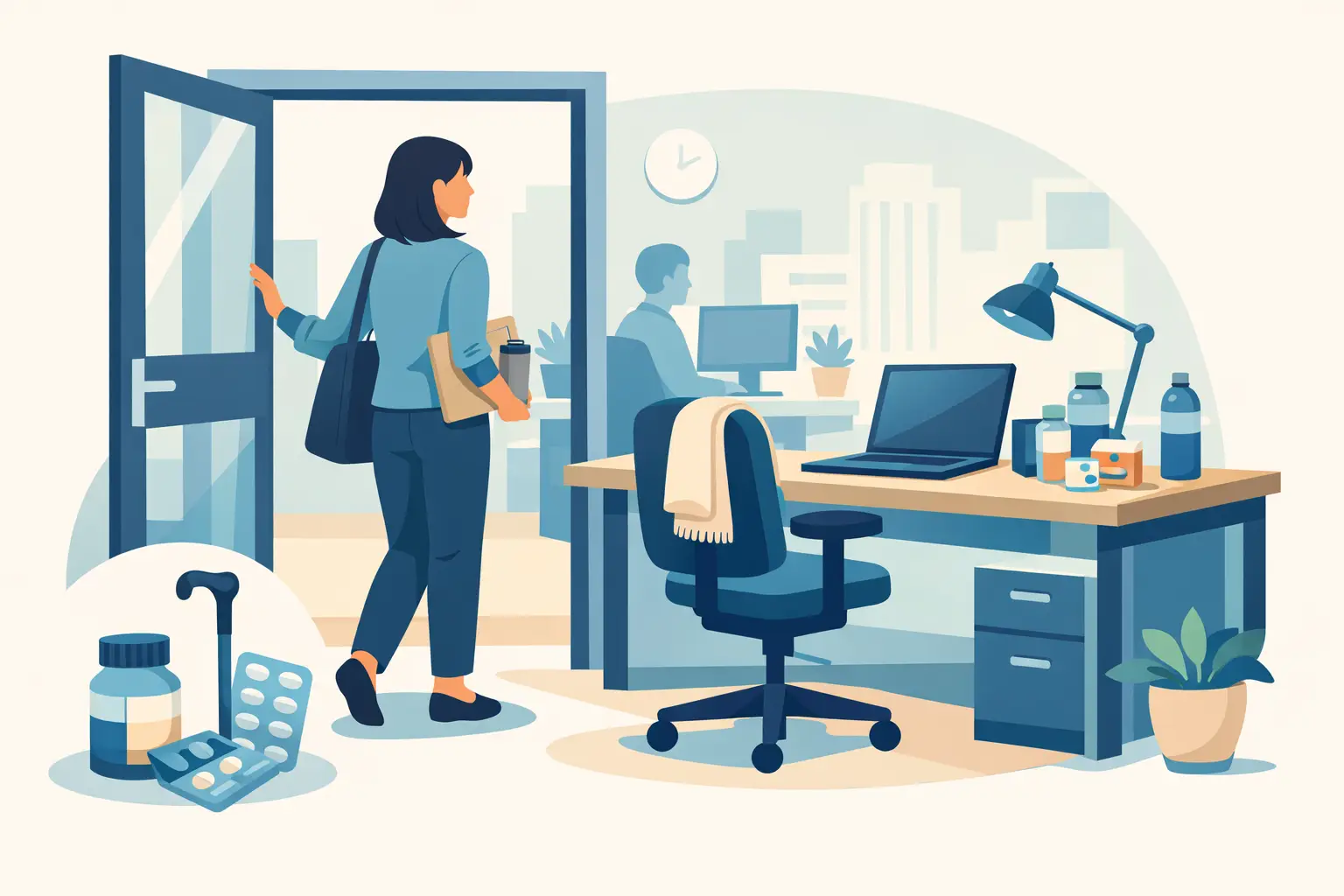
Leah had spent eight months away from her office job with long Covid, migraines and severe fatigue. She wanted to go back because she missed the routine, the people and the financial breathing room. But she also knew that trying to work exactly as she had before could leave her in bed for days.
This returning to work with chronic illness example is not about finding a perfect plan. It is about building a realistic one, with enough room for symptoms to change. Returning to work can be a positive step, but it should not mean pretending you are no longer disabled or unwell.
A returning to work with chronic illness example
Before Leah agreed a start date, she wrote down what work was hardest: travelling at rush hour, long video meetings, bright office lights and back-to-back tasks without a proper break. She also noted what helped: a later start, regular screen breaks, working from home and having instructions in writing when brain fog was bad.
She asked for a meeting with her manager and explained that she wanted to return gradually. She did not need to share every detail of her medical history. Instead, she focused on how her conditions affected her at work and what changes could help her do the job.
They agreed a phased return. For the first two weeks, Leah worked three short mornings from home. She was not expected to clear the backlog that had built up while she was off. Her manager chose a colleague to cover urgent work, and they arranged a brief check-in at the end of each shift rather than constant messages throughout the day.
In weeks three and four, Leah increased her hours slightly and came into the office once a week, outside peak travel times. Her workstation was moved away from harsh lighting, and she could step away from meetings if a migraine started. The plan was reviewed every fortnight, not treated as a promise that she would be fully back to normal by a fixed date.
That last point matters. A phased return is there to test what is manageable, not to prove your commitment. When Leah had a flare-up after an office day, the answer was to adjust the plan, not to push through and hope for the best.
Start with what your health actually allows
It can be tempting to begin with what your employer needs or what you used to manage. Start somewhere else: what can you do without making your health worse over the following day or two?
Think about the full cost of a working day. It is not only the hours at your desk. It can include getting washed and dressed, travelling, concentrating, preparing food, managing medication, recovering from social contact and dealing with pain or fatigue afterwards. If a four-hour shift means you cannot safely cook, wash or attend a medical appointment for several days, it may not yet be sustainable.
A simple symptom and activity diary can help. You do not need to make it complicated. For a couple of weeks, note the activity, how long it took, symptoms during it and how you felt afterwards. This gives you useful language for a workplace conversation: “After two consecutive meetings, my concentration drops sharply” is clearer than “I get tired.”
Your clinician may be able to advise on returning to work too. A fit note can say you may be fit for work if changes are made, such as altered hours, amended duties or working from home. It is still worth having a direct conversation with your employer. A fit note opens the door, but it does not design the arrangement for you.
Ask for adjustments, not favours
If your condition has a substantial and long-term effect on day-to-day activities, you may be protected by the Equality Act 2010 in England, Scotland and Wales. Employers may have a duty to make reasonable adjustments where they know, or could reasonably be expected to know, that you are disabled. What is reasonable depends on the job, your needs and the size and resources of the organisation.
That does not mean every request will be possible. It does mean you should be taken seriously, and that “this is how we have always done it” is not a good enough response.
Adjustments can look different for different conditions. They may include flexible start and finish times, home or hybrid working, extra rest breaks, a reduced workload during a phased return, different equipment, written instructions, a quieter workspace, time off for treatment, or changing how performance targets are measured.
Try to be specific. Rather than asking generally for flexibility, explain what flexibility would mean in practice. For example: “On days when fatigue is severe, I need to start at 10am and make up time only if it is safe for me to do so.” Put any agreed plan in writing, even if it is just an email confirming hours, duties, review dates and who to contact if your health changes.
Be honest about the risks of going back too quickly
People often feel pressure from themselves as much as from an employer. You may worry colleagues will think you are unreliable, or that asking for help will harm your career. These feelings are common, especially after a long absence. They are not proof that you are asking for too much.
There are trade-offs. Working more hours may improve income and confidence, but it can reduce the energy available for care, family, appointments and rest. A role you once enjoyed may now need different boundaries. For some people, a return to the same job is right. For others, reduced hours, different duties, self-employment or a new role may be safer.
It also depends on whether your symptoms are predictable. Someone with stable arthritis pain may plan a regular timetable. Someone with epilepsy, Crohn’s disease, ME/CFS, migraine, multiple sclerosis or fluctuating mental health may need more flexibility because good and bad days are less predictable. Neither situation makes you less capable. It simply calls for a plan that reflects reality.
Keep benefits and pay in the picture
Before changing your hours, check how pay will affect any benefits you receive. If you claim Universal Credit, report changes to work and earnings promptly through your journal. Your award may reduce as earnings rise, but depending on your circumstances, it may not stop straight away. If you get disability benefits such as Personal Independence Payment, starting work does not automatically end your claim. PIP is based on how your condition affects daily living and mobility, not whether you have a job.
However, a new job or increased hours can lead to questions about your claim, particularly if the work appears inconsistent with the difficulties you described. That does not mean you cannot work. Keep clear records of adjustments, support you need, symptoms and the limits of what you can do. Work can be possible with aids, rest, flexibility and considerable effort.
If you have been receiving Statutory Sick Pay, occupational sick pay or New Style ESA, ask for guidance before agreeing a change. The rules can be different depending on your circumstances. Access to Work may also help with practical support connected to doing your job, such as specialist equipment, travel support or a support worker. It is worth exploring early, as arrangements can take time.
Make reviews part of the agreement
A return-to-work plan should have review points from the beginning. Leah and her manager agreed to meet every two weeks for ten minutes. They looked at hours worked, tasks completed, symptoms and whether the workload was causing a delayed crash.
A useful review is not a test of whether you have “recovered enough”. It is a chance to ask: Is this still safe? What is helping? What needs to change? If your manager says an adjustment is difficult, ask what alternative could meet the same need. There is often more than one route to a workable solution.
If conversations become uncomfortable, take someone with you where your workplace allows it, such as a union representative, colleague or support person. Keep notes after meetings. If you feel pressured to return before you are ready, or your agreed adjustments are being ignored, get advice before making a decision you may struggle to undo.
Going back to work with chronic illness is not a straight line from sick leave to full capacity. It is a conversation, a trial and sometimes a series of changes. You are allowed to value work while also protecting your health. Real talk for real people means recognising that both things matter.