
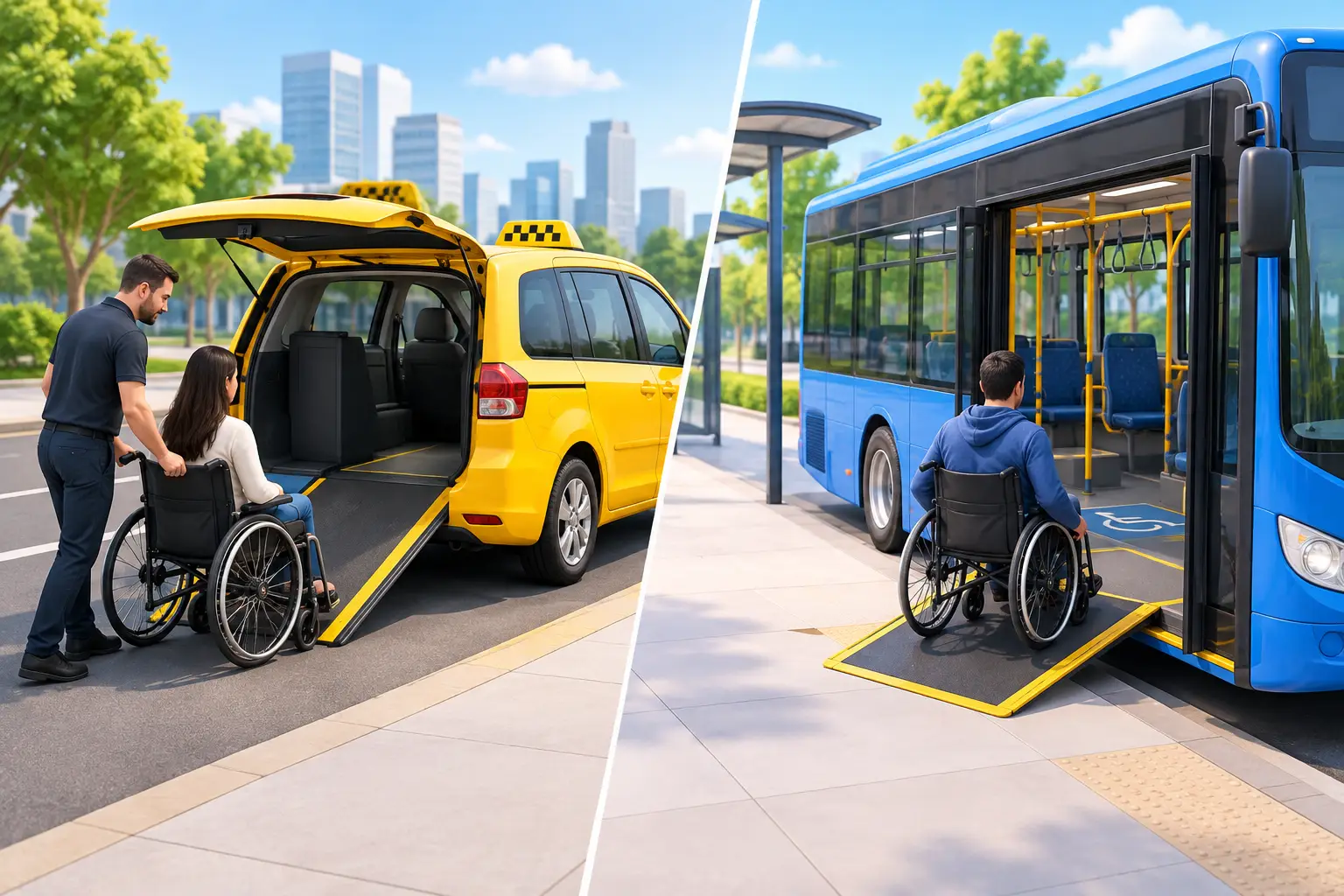
A missed appointment, a wet pavement, a driver who cannot secure your chair properly - the choice between a wheelchair taxi versus accessible bus is rarely just about getting from A to B. It can decide whether a journey feels manageable, exhausting, expensive or simply not worth attempting.
Both options can be useful, and neither is automatically the right answer. The better choice depends on your mobility equipment, energy levels, budget, where you live, whether you are travelling alone, and how much control you need over the journey. Here is some real-world help with weighing it up.
Wheelchair taxi versus accessible bus: the key difference
A wheelchair-accessible taxi is a private journey booked for you, usually from door to door. The vehicle should have a ramp or lift and a secure space for a wheelchair. Depending on the operator and vehicle, you may travel in your own chair or transfer to a passenger seat if that is safe and preferable for you.
An accessible bus is shared public transport. Most newer local buses have a low floor, ramp and a designated wheelchair space. Some areas also offer community transport, dial-a-ride services or accessible minibuses, which sit somewhere between a standard bus and a taxi because they may need pre-booking but serve several passengers.
The difference is not simply private versus public. A taxi can offer more control, but that does not guarantee a good experience. A bus can be low-cost and regular, but that does not mean the route, stop or wheelchair space will work for you on the day.
When a wheelchair taxi may be the better choice
A wheelchair taxi is often the practical option when the journey itself needs to be as predictable as possible. This can matter for hospital appointments, early morning travel, travelling with bags or medication, unfamiliar places, or days when pain, fatigue or anxiety are higher than usual.
The biggest benefit is door-to-door travel. You do not have to reach a bus stop, wait in bad weather or manage a pavement with dropped kerbs that are not quite where they ought to be. If your destination has an awkward entrance, the driver may also be able to drop you closer than public transport allows.
It can also make sense if you use a powered wheelchair, have a larger chair, need space for equipment, travel with a personal assistant, or cannot safely transfer. Tell the operator exactly what chair you use, including its dimensions and combined weight with you in it. Do not assume that the word “accessible” means every vehicle can take every wheelchair.
There is a dignity side to this too. When transport is reliable, you can focus on why you are travelling rather than spending all your energy preparing for what might go wrong on the way.
The trade-offs with taxis
Cost is the obvious one. A taxi fare can quickly become unaffordable, especially for regular appointments, work, visiting friends or journeys outside your local area. Availability can be another problem, particularly in rural areas, at weekends and in the evening. A vehicle suitable for a wheelchair may need to be booked well ahead.
Quality varies between firms and drivers. A good driver will ask the right questions, use the restraints correctly, give you time and speak to you rather than only to whoever is with you. A poor experience can leave you feeling rushed or unsafe. If you find a reliable local firm, keeping its number and booking details saved can remove some stress from future journeys.
Before confirming a booking, ask whether the vehicle can take your exact wheelchair, whether you will remain in it, how much notice they need, what the full fare is, and whether waiting time or return travel costs extra. If a driver says they cannot carry you because you are a wheelchair user, ask calmly for the reason and the company’s exemption policy. Taxis and private hire vehicles have legal duties around wheelchair users, though exemptions can apply in limited circumstances.
When an accessible bus may work better
For regular, straightforward trips, an accessible bus can give you more independence at far lower cost. In England, an eligible disabled person’s bus pass generally offers free off-peak travel, while arrangements differ across Scotland and Wales. Local rules matter, so check what applies where you live.
Buses can be especially useful when the route is frequent, the stops are close to both ends of your journey, and you know the vehicles on that service are consistently accessible. You do not need to arrange every trip in advance, and that freedom can make it easier to say yes to a coffee, a class, a support group or a last-minute errand.
For some people, using the bus is also a welcome part of everyday life. It is a chance to be out in the community without each journey being a major logistical operation. That independence matters, even if others do not always understand why.
The trade-offs with buses
The designated wheelchair space can be unavailable. It may be occupied by another wheelchair user, a pushchair or luggage, and the outcome is not always handled fairly. A bus driver should not expect a wheelchair user to travel without the appropriate space, but the reality can still be frustrating and uncomfortable.
Even when the bus itself is accessible, the whole journey may not be. A steep kerb, blocked pavement, roadworks, a narrow shelter, a broken real-time display or an inaccessible toilet at the destination can turn a short trip into a difficult one. Accessibility is a chain. One weak link can make the rest irrelevant.
Timing and crowding also affect whether a bus is realistic. A ten-minute journey may require leaving home forty minutes early, allowing for a missed bus, a full wheelchair bay or a ramp problem. If you have limited energy, that uncertainty has a genuine cost.
Think beyond the fare
It is tempting to compare only the price of a taxi with the price of a bus ticket. But the real cost of travel includes time, effort, pain, stress and what happens if things do not go to plan.
A bus might be free with a pass but take two hours and leave you depleted for the appointment you travelled to attend. A taxi might cost more but mean you arrive with enough energy to take part in your day. Neither choice is selfish or wasteful. Your energy is a resource, and it is reasonable to protect it.
Equally, a taxi is not always the less stressful option. If you have had unreliable drivers, long waits or uncomfortable journeys in poorly fitted vehicles, a familiar bus route may feel safer and more within your control. Your previous experiences are relevant evidence, not something to brush aside.
A practical way to choose for each journey
Start with the non-negotiables. Can your wheelchair fit safely? Do you need to arrive at a fixed time? Can you manage the distance to and from bus stops? Will you be travelling after dark, carrying equipment or returning when you are likely to be tired?
Then consider your backup plan. If the bus does not have room, can you wait for another without missing something important? If the taxi is late, is there a contact number and enough time to rearrange? A journey becomes more manageable when you know your Plan B before you leave home.
For a new route, try it on a lower-pressure day if you can. Take a note of accessible stops, where the dropped kerbs are, and whether there is a suitable place to wait. For a taxi, consider booking a short local journey first to check that the company understands your needs and secures your chair correctly.
If a travel provider treats you badly, record what happened while it is fresh: date, time, vehicle or registration details, route, what was said and any witnesses. Complaints are tiring, and you should not have to become an expert in transport rules just to be treated decently. Still, a clear record can help if you decide to raise the issue with the operator or local authority.
You are allowed to choose the option that feels safer
There can be pressure to use the cheapest option, to prove you are independent, or to push through a journey that drains you. Real life is not a test of how much difficulty you can tolerate. Independence can mean catching a bus when it suits you, booking a taxi when you need one, or deciding the journey needs more planning.
Talking Really is a judgement-free space because these decisions are often about far more than transport. If travel is making you feel cut off, talk it through with people who understand that a “simple journey” is not always simple. The right option is the one that gets you where you need to be with the greatest possible safety, dignity and breathing room.